




















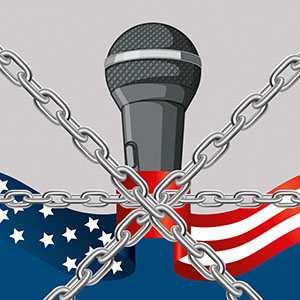
Since the beginning of his second term, Donald Trump has intensified his longstanding campaign against the press. The labeling of any opposition or critical coverage as “fake news” that began in his first term has now evolved to include taking actions that punish coverage of which he disproves. The message is clear: if you cross him, there are consequences.
Reporters have been denied access, lawsuits have become rampant, and regulators are used as tools of intimidation. The intention is not merely to win cases but to instill fear, making those with a platform think twice before speaking, which effectively muzzles free speech.
Targeting the Press
The Department of Justice under the Trump Administration recently rolled back a longstanding rule that prevented prosecutors from seizing the phone and email records of journalists.
This opens the door for renewed surveillance of reporters under the pretext of leak investigations, allowing the government to trace sources behind critical stories. It marked a sharp break from the norms that protected the independence of the press.
The Pentagon also introduced a new press policy requiring most Defense employees to seek approval before speaking with journalists, even off the record. This change cut off the flow of public information, silencing military analysts who once provided key insights into operations that flesh out the official story. The result was less transparency and a more controlled narrative.
Finally, the White House removed the Associated Press from the presidential press pool for several months, barring its reporters from briefings and Air Force One after they ran a story that angered the president.
A federal court later ruled that the administration had violated the outlet’s right to cover public events, serving as a reminder that suppressing the press isn’t just intimidation, it’s unconstitutional.
These moves don’t require overt censorship to be effective. The mere threat itself chills what journalists feel safe reporting.
Silencing Insiders
Inside the government, the chilling effect is louder than any press conference. Inspectors General, career experts and other safeguards have been sidelined in favor of loyalists. Analysts who present facts contradicting the preferred narrative often find their work altered or their roles diminished. Policies that once protected reporters and their sources have been rolled back.
The lesson for public servants is clear: keep your head down or risk your job. Early in his second term, Trump reinstated and expanded a version of Schedule F, which reclassified thousands of federal employees as political appointees. This maneuver made it easier to fire civil servants who disagreed with the administration’s position, sending a message that expertise and truth-telling were liabilities.
This reclassification undermined decades of protections meant to keep federal agencies apolitical. Trump also purged at least seventeen Inspectors General, including those investigating waste, ethics violations, and abuse of power.
These firings hollowed out internal oversight and signaled to remaining watchdogs that loyalty mattered more than legality. Even after a court later found the dismissals to be unlawful, the damage to government transparency was already done.
Additionally, the Department of Defense circulated internal memos discouraging staff from speaking with the media, framing any unauthorized communication as a potential security threat. This kind of language casts openness as a danger. It prevents honest discussions, particularly from analysts whose professional duty is to inform the public.
Silencing the People’s Voice
This crackdown on free specch also has a profound impact on ordinary Americans. At the Broadview, Illinois immigration facility, Department of Homeland Security and ICE agents fired tear gas and rubber rounds at protesters and legal observers during peaceful demonstrations.
This excessive force served as a physical warning that exercising the right to assemble now carried personal risks. The administration went further by deploying the National Guard to police immigration protests across the Chicago area.
Although billed as a public safety measure, this deployment blurred the line between civilian demonstrations and domestic military control, intimidating communities that had long relied on public protest as their primary form of representation.
When lawsuits followed, a federal judge found that DHS agents had targeted journalists and peaceful demonstrators, issuing an injunction to curb the government’s tactics. Even so, the precedent was clear: the administration was willing to use federal power not just to contain unrest but to suppress expression itself.
These actions struck at the core of the First Amendment, reminding citizens that their freedom to speak or gather can be undermined when those in power find it inconvenient.
The Systemic Erosion of Free Expression
Taken together, these examples depict a deliberate pattern rather than a series of isolated abuses. What began as a rhetorical war on “fake news” has expanded into a coordinated effort to control information at every level of public life. The press faces intimidation and access denials, federal employees are punished for speaking the truth, and citizens are deterred from exercising their rights.
This systematic erosion of free expression not only threatens journalism but also undermines accountability within government institutions.
By branding unfavorable reporting as “fake,” the administration seeks to delegitimize dissenting voices and erode public trust in independent media. Meanwhile, federal employees feel pressured to prioritize loyalty over integrity, which stifles scrutiny and oversight.
Why Should I Care?
You might not be a journalist or a protester. You may even support some of the president’s policies. However, it’s essential to understand that free speech is not a privilege reserved for one side; it is the foundation of a free society. When a government begins to normalize punishing speech it disapproves of, that power never remains with just those in favor.
Today, the target may be a news network you don’t watch. Tomorrow, it could be a pastor, a union organizer, a small newspaper in your town, or even you.
If we lose the right to question those in power, we jeopardize the very promise of the United States. The cost of silence is always greater than the cost of speaking out.
The slide toward tyranny doesn’t happen all at once. It occurs through countless small choices to look the other way. Let’s not make another one today.