
















Rogers Senteza used to measure success in numbers — balance sheets and ledgers, neat columns and bottom lines.
Now, he measures in angles and inches, marks and levels.
“I felt like accounting — after a certain period of time, you’ve done it all,” he said. “It’s not challenging anymore. But with construction, there are new challenges every time… new materials, new tools. Every time is exciting.”
The shift from accounting to construction wasn’t part of the original plan.
Senteza moved to the United States from Uganda four years ago. He already had a bachelor’s degree in accounting and a future that looked promising on paper — predictable, secure and stable. But something about that path never quite fit him.
“As a kid, I used to build small houses out of mud,” he said. “I’d be so proud of them. If someone stepped on it, I’d be very mad.”
He laughs at that now, but it stayed with him. It was something small, but hard to describe. It pointed to a different kind of satisfaction, one he hadn’t yet put into words.
Most people, he said, don’t grow up dreaming of being a builder. So he didn’t either. Instead, he chose a more traditional and respected path into accounting.
“I had a degree already,” he said. “But this is what was in my heart.”
Starting over in a new country, with bills to pay and little free time, made the realization harder to act on. Still, he chose to begin again.
At Madison College, Senteza found the Construction and Remodeling program almost by accident. Someone mentioned it to him during a talk, and he immediately knew it was right for him.
“The very moment I saw the classes,” he said, “I felt, ‘This is exactly where I need to be.’”
The transition didn’t come easily. There were moments when progress felt impossible, when every step forward seemed to bring two steps back, but he kept going through sheer hard work.
He worked 40 hours a week while attending school.
“I had to make sacrifices — cut out things like watching TV. I slept early and woke up early so I could study and still go to work,” he said.
He had to relearn how to measure, switching from centimeters to feet and inches, and picking up an entirely new vocabulary.
“I started in the deep end,” he said. “I didn’t even know what a joist was.”
Then there was the language barrier. “If you’re still trying to think about what was just said,” he explained, “you’re already behind — because everything is new.”
To keep pace with his classmates, his days stretched into nights.
“I would sleep at 6 p.m. and wake at 1 a.m., just to study,” he said. “I had to do extra — watch videos, slow them down, go back — just to keep up.”
Even the basics felt unfamiliar at first. “Simple things, like using a tape measure — I felt like I needed to learn them.”
Over time, he found ways to manage the pace. He adjusted his schedule and, with support from his employer, reduced his workload to focus more on school.
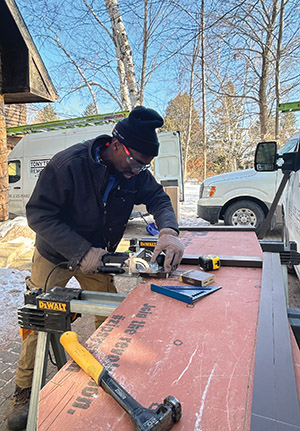
Tony Trapp, owner of Tony Trapp Remodeling, offered Senteza flexible part-time work while he was still in the program and became a mentor — helping him build skills, providing transportation and even giving him space and materials to practice carpentry on his own time.
Under Trapp’s guidance, Senteza spent weekends designing and building a shed from scratch, drawing the plans himself, constructing the frame, installing windows and experimenting with different materials, learning through trial and error.
“He’s incredibly hardworking, always looking for opportunities,” Trapp said. “He’s in it for the long haul.”
For Senteza, that mindset has been key.
“I don’t think there’s a formula,” he said. “It’s about how bad you want it.”
Now, as a graduate of the Construction and Remodeling program, Senteza is focused on continuing to grow in the trade, gaining experience, refining his skills and building a future. The work is different from accounting in every way. It’s strenuous, demanding and constantly changing. But for Senteza, that’s exactly what he wanted.
Each project brings something new to figure out, something tangible to create, something he can step back and see at the end of the day.
Just like the houses he once built out of mud — only now, they stand.